
Share

Three months into building our Pricing Index, several themes have emerged. Pricing in AI is evolving faster than most teams anticipated, and the companies that treat pricing as a core product capability and a piece of critical infrastructure are standing out.
Here, we’ll explore some key themes observed across chatbots, developer tools, image and video generation platforms, enterprise LLMs, data platforms, and more. These observations are drawn directly from how companies are structuring their pricing, packaging, and credit models.
For most of the Access Era, the relationship between price and value was relatively static. Because the value was predicated on accessing the software, you could pick a model, lock it in, and revisit it once a year. AI has challenged that assumption. The cost to deliver value now shifts with model releases, inference calls, and new capabilities. And across the more than 50 companies cataloged in our Pricing Model Index so far, the most resilient monetization strategies tend to be built for exactly this kind of velocity.
Which pricing era are we in now? Get oriented with the Monetization Operating Model whitepaper.
Takeaways at a Glance
- Among pricing models analyzed, single-track pricing models are becoming the minority; hybrid is the norm.
- Credits now serve three distinct functions across the industry: mapping compute costs, abstracting complex resource bundles, and gating premium access.
- The split between consumer and API pricing is becoming a key design pattern.
- Packaging is shifting from features and seats to consumption capacity, speed, and model access.
- AI-native companies are iterating on pricing faster than incumbents, and the ability to change pricing without breaking customer trust is emerging as a structural advantage
The current state: Hybrid as the norm, not the exception
If there is a single, headline takeaway from the Pricing Index so far, it is this: singularly-focused pricing models seem to be the minority, due to their narrow value equation. The majority of AI companies we’ve analyzed use some form of hybrid structure, combining subscription tiers with usage-based elements, credit pools, or consumption-based overages.
Across the Pricing Index, freemium models with tiered subscriptions and usage constraints have emerged as the most common consumer-facing pattern. On the API side, pay-per-token or pay-per-call is still standard, often with prepaid credit mechanics layered on top for cost predictability. Companies with more mature monetization strategies tend to run both motions simultaneously, with distinct pricing architectures for consumer and developer audiences.
This represents a notable shift from recent years. Not long ago, the debate centered on subscription versus usage-based pricing—a binary choice to be made. Today, the question is how to layer multiple pricing dimensions without creating confusion for buyers or operational strain for internal teams.
Credits are everywhere, but they’re being deployed differently
Nearly every category in the Pricing Index features some version of a credit model. But the term "credits" masks considerable variation in how they actually work. While they might seem uniform on the surface, we’re seeing credits used in three primary ways:
- Compute proxies: Credits map directly to units of work, to a known unit of inference, or to GPU time, like ElevenLabs’ usage-based characters or Runway’s credits-per-generation.
- Abstracted value bundles: A single, spendable balance that bundles different types of actions with varying costs, such as Clay’s credits-per-data-enrichment.
- Access gating: Credits are used to meter premium usage within a fixed tier, like Perplexity’s daily Pro search queries.
The developer tools category illustrates this range well. Cursor's credit system maps to underlying model costs, letting developers see the inference economics of their choices. Lovable allocates a fixed monthly credit pool that refills on a recurring basis. Windsurf has moved through several iterations of this question itself, most recently replacing a credit-based system with fixed usage quotas across a tier structure—a shift made in part because of user feedback regarding cost predictability.
When the meaning of credit varies substantially like this, companies with a clean customer experience tend to benefit from credits clearly reflecting either a customer-legible value metric or the underlying resource economics.
The consumer/API split is becoming common
A notable number of companies in the Pricing Index now maintain two separate pricing architectures: one for consumer or workspace users, and another for API developers. This isn’t just a matter of offering two products but actually is reflective of a fundamental difference in how value is delivered and consumed.
This is why treating pricing as infrastructure is so critical. To support a dual-track strategy, a company’s billing systems has to be robust enough to handle high-volume, real-time API metering while managing traditional seat-based subscription lifecycles for the front end at the same time.
ChatGPT's consumer tiers use subscription-based packaging with usage caps and overage mechanics. Its API uses pure token-based consumption with prepaid credits. Perplexity has a similar pattern, with seat-based subscriptions for its research product and usage-based pricing for its Sonar API. Runway operates a credit-based subscription for its creative platform and a separate credit-per-operation model for API access.
This dual-track approach introduces real complexity for product, finance, and engineering teams, but the companies executing it well gain a meaningful advantage in the fact that they’re able to optimize each motion independently, matching the pricing structure to how each audience actually engages with the product.
Good/Better/Best packaging persists, but the gates have changed
The Good/Better/Best (GBB) framework is still the most common packaging model we see, but what’s changed is what separates the tiers. In traditional SaaS, the gates were features and seats more often than not. With AI, the gates increasingly center on consumption capacity, model access, and speed (or the credit structures we just looked at).
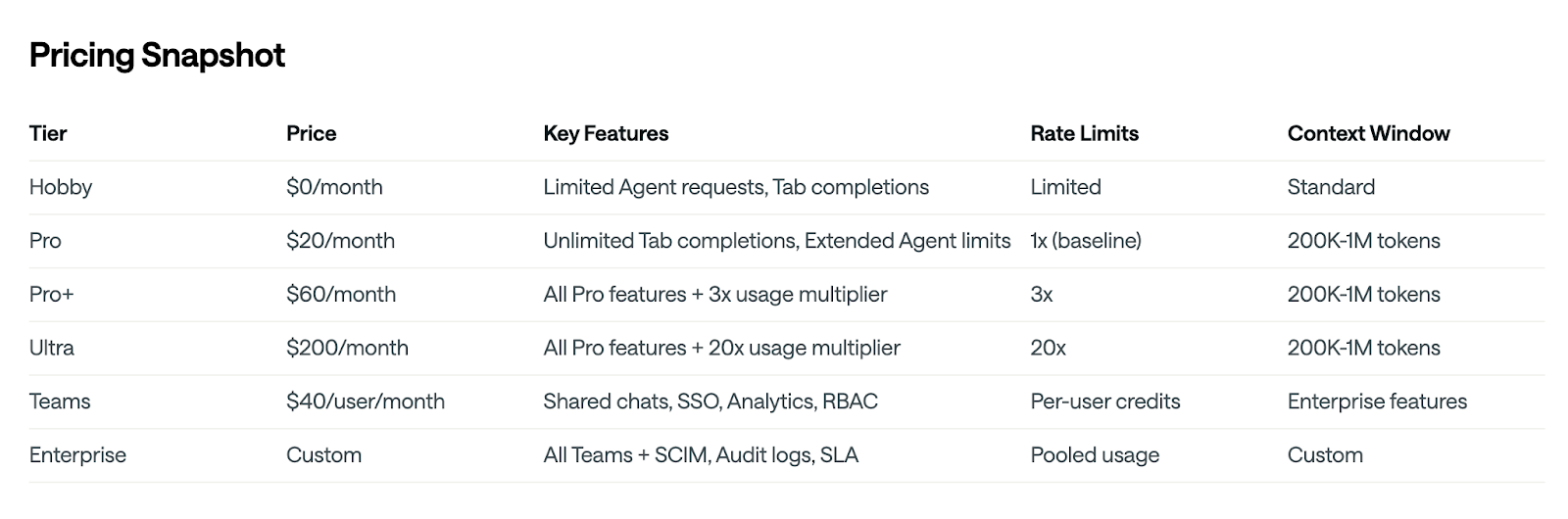
Midjourney differentiates tiers by GPU time allocation. ElevenLabs scales credit pools, model access, and voice quality across tiers, with higher plans unlocking faster processing and advanced features. Cursor scales credit pools by tiers from $20 to $200, providing developers a clear signal of relative intensity. Gamma varies credit consumption rates per action rather than per-seat access.
These patterns suggest that AI-native companies are finding that packaging based on "how much" and "how fast" may work better than packaging based on "which features." This shift would require pricing infrastructure that can meter, rate, and bill on dimensions that traditional subscription billing wasn’t designed to handle.
Enterprise AI pricing remains opaque
At the other end of the spectrum from the consumer freemium model, enterprise-only platforms like Harvey, Hebbia, Glean, Scale AI, and Snorkel AI largely avoid public pricing altogether. Their models are custom-quoted, often seat-based, with consumption layers negotiated during sales cycles.
For enterprise software, this isn’t unusual, but it is worth noting in the context of AI because it seems to create a bifurcation in the market. Consumer and prosumer platforms tend to compete on pricing transparency and self-serve conversion, while enterprise platforms tend to compete on value narrative and customization. Very few companies successfully bridge both worlds with a single pricing architecture.
The companies attempting that bridge, like Writer (self-serve starter tier alongside custom enterprise contracts) or Scale AI (PayGo plus custom agreements), are useful reference points for how to serve both motions without diluting the value proposition of either.
Pricing velocity as a competitive advantage
One of the more interesting findings from the Pricing Index is how frequently AI companies change their pricing. Cursor has gone through four major pricing structure changes in under two years. ChatGPT has introduced and restructured multiple tiers within a similarly compressed timeline. ElevenLabs has expanded and recalibrated its credit pools across several iterations.
This pace of change doesn’t necessarily signal instability and may instead be a sign of companies actively iterating toward price–market fit in a space where underlying cost curves, competitive dynamics, and customer expectations are shifting simultaneously.
Companies that can iterate quickly without breaking customer trust or creating billing errors are finding themselves with a structural advantage. The ones that can’t may find themselves stuck on pricing models that no longer reflect their economics, or they risk introducing changes that create confusion and churn.
Considerations for monetization leaders
All the work on this Pricing Index has surfaced a set of practical considerations for founders and teams navigating their own monetization strategies.
Is single-tracked pricing your only option? Patterns across the Pricing Index suggest that singular subscription or pure usage-based models may not actually be ideal for most AI products. A hybrid structure, where subscription offers predictability and usage-based elements capture variable value, can give teams the flexibility to adapt as costs and customer behavior evolve.
Credit model designs for the customer are more approachable. Credits mapping to customer-legible value (documents processed, agents run, minutes generated) might perform better than credits that abstract away meaning. If your customer can’t explain what a credit buys without looking it up in your documentation, you might want to simplify your system.
Separating consumer and API pricing architectures. If your product serves both audiences, it can be tempting to unify pricing under a single model. We’d suggest caution here, though—what we’ve seen in the Pricing Index suggests that the two audiences tend to have different expectations around billing granularity, cost predictability, and purchasing behavior.
Invest in pricing infrastructure that supports iteration. The companies with the most effective pricing strategies aren’t necessarily the ones that got it right on the first try. They tend to be the ones that built systems capable of supporting rapid, safe pricing changes without disrupting active customers or creating reconciliation challenges for finance teams.
Treat pricing transparency as a trust mechanism. Across the Pricing Index, the companies that appear to have higher customer sentiment around pricing are those where users can clearly see what they’re paying for and why. Less transparency can work in enterprise sales contexts where value is even more variable and negotiated terms are the norm. In self-serve and prosumer markets, clarity tends to be preferred.
The AI Pricing Index is an ongoing initiative cataloging the pricing models, packaging structures, and credit models of leading AI platforms. We add new entries regularly and update existing ones as companies evolve their monetization strategies. Explore the full Pricing Index at metronome.com/pricing-index.





.png)