
Share

Welcome to the Pricing Model Spotlight series. This is a recurring feature where we tear down the packaging mechanics, infrastructure choices, and unit economics of companies on the leading edge of monetization. Each post deconstructs how modern platforms are navigating the transition to usage-based, hybrid, and agentic billing frameworks.
It’s been clear to us since launching our Pricing Model Index, and after analyzing over 50 leading AI and usage-based products, that there are common themes emerging across the industry. There’s no silver bullet to handle the changes coming at us, but there are clear signals that singular pricing models are becoming a minority. Pure seat-based SaaS struggles to capture the value of enhanced automation, while pure consumption-based tokens abstract away legible value from the end customer. To survive the shift to agentic software, modern monetization increasingly requires a hybrid approach.
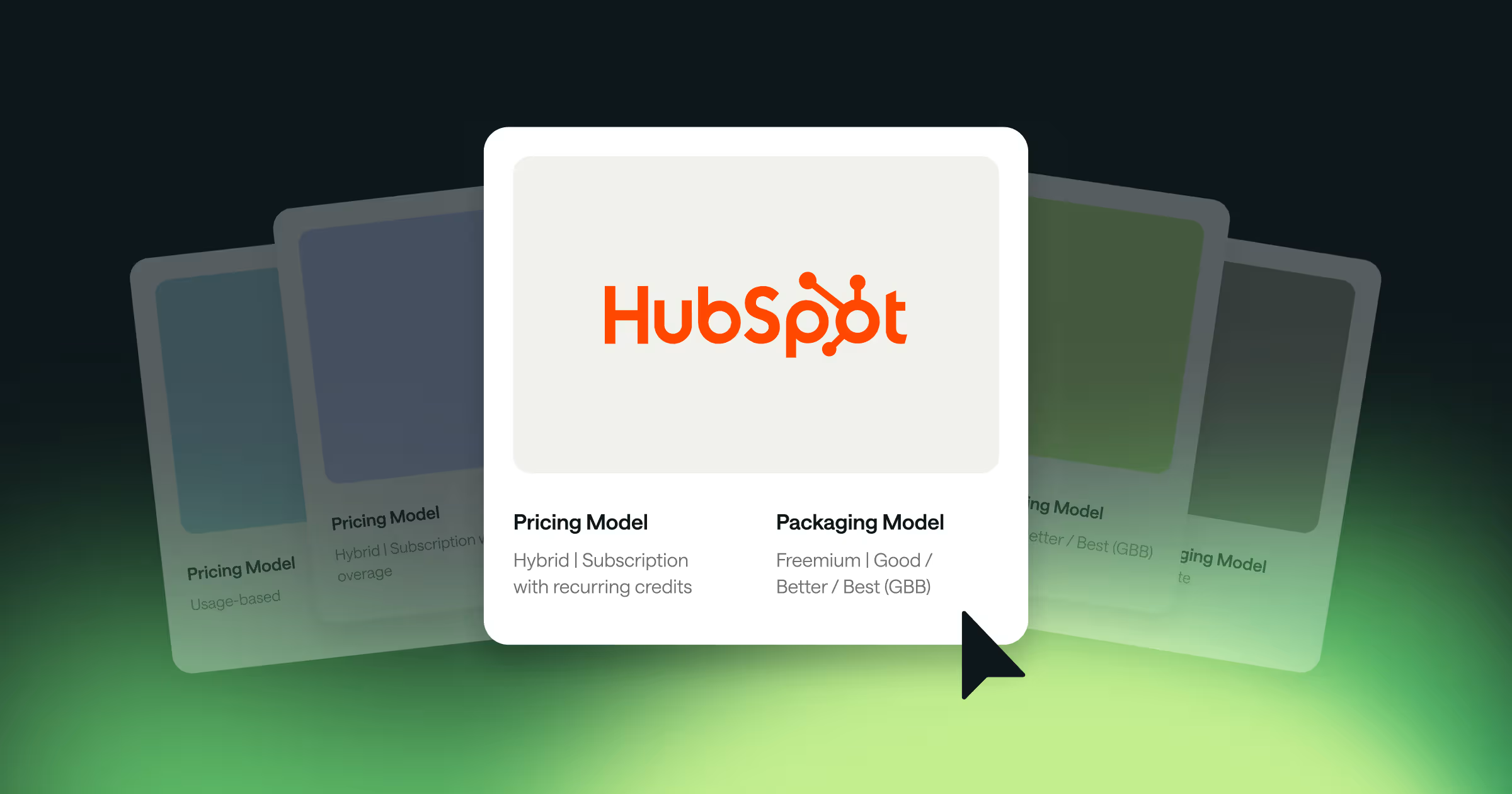
For this second feature in the Pricing Model Spotlight series, we’re taking a close look at a giant that’s completely reinventing its core engine. Recently, HubSpot rolled out a shift to the monetization strategy for its Breeze AI agents (specifically the Breeze Customer Agent and Breeze Prospecting Agent). They moved away from input-based actions to a pure outcome-based pricing model, powered by a unified credit layer.
Read on to get a close look at how HubSpot structures this model, the underlying unit economics, and why their Smart CRM infrastructure gives them a monetization moat most standalone point solutions can only dream of.
The anatomy of the Breeze model: A triple-layer hybrid
HubSpot resisted the pitfall that’s easy for many companies to slip into: they didn't get rid of their legacy playbook just to introduce AI. Instead, they’ve constructed a sophisticated, three-layer pricing model:
- The base subscription layer: To access advanced Breeze agents, customers must still be on a Professional or Enterprise tier of HubSpot's core Hubs. This layer serves as the predictable, recurring foundation of their monetization engine.
- The shared credit pool: HubSpot offers an abstracted HubSpot Credits system. Plans come with a baseline of included credits that varies by tier, creating a predictable recurring floor. Overages are handled through add-on capacity expansion packs.
- The outcome trigger: On top of the credit system is an agent-level pricing layer that translates raw credit consumption into business-meaningful units like resolved support conversation or qualified lead that’s recommended for outreach. Credits still power the compute underneath, but customers increasingly transact in units tied to agent value events rather than tokens or API calls. Not every Breeze feature has moved to this layer, and the "outcome" definition varies by agent, but the direction is clear: the unit of pricing is migrating from raw usage toward agent-level outputs.
The Shift: Old Activity vs. New Outcome
Why most AI startups can’t ship outcome pricing yet
On a whiteboard, charging only when the software works sounds like the ultimate value alignment, but in production, it can be a massive financial risk. If an AI agent fails frequently, handles infinite loops of unhelpful text, or burns massive stacks of tokens without solving the user’s issue, the vendor eats 100% of the compute cost.
HubSpot is clearly aware of this and has crafted a setup that allows them to comfortably offer low-cost resolutions. The biggest aspect that allows them to do this is their data moat.
Breeze agents aren’t generic, thinly integrated AI applications. They live right within HubSpot’s Smart CRM, natively inheriting deep company context, relationship history, historical ticket resolutions, and brand guidelines. All of that context drives consistency and adds a tangible layer of value that competitors struggle to match, since they have no direct access to that value layer and thus cannot compete on it. The Customer Agent’s ability to hit a high resolution rate autonomously across early implementations allows HubSpot to reliably underwrite any financial risk of unpaid or unresolved conversations.
One takeaway for founders: If your product's context layer is weak, your pricing model likely should stay closer to raw consumption (tokens/credits) to protect your margins. The deeper your product's data integration, the closer you can move to outcome-based pricing.
Guardrails and edge cases: The technical reality of billing results
For monetization and engineering teams, billing on outcomes introduces complex state tracking. HubSpot’s documentation outlines the strict guardrails required to make this work for them:
A time-bound evaluation window: An automated assessment is triggered 72 hours after the agent's last response. Credits are only consumed if no human handoff, transfer request, or negative feedback occurs during that window; then, the conversation is marked as successfully resolved.
The human escape hatch: For credits to be consumed, three conditions must all hold during the 72-hour window: the agent referenced a content source or performed an action, the visitor did not request a transfer to a human, and the visitor did not leave negative feedback on the agent's last response. If any one of those fails, the conversation isn’t counted as resolved, and there is no charge. The customer is never billed for a conversation the agent didn't fully own.
Granular- vs. macro-outcomes: Notice that HubSpot now bills for micro-outcomes (a resolved support ticket or a qualified lead handoff) rather than macro-outcomes (a closed-won deal or actual revenue generated). Tying pricing to the macro introduces too many external variables (e.g., a human sales rep fumbling a great lead), which ruins revenue predictability.
The competitive wedge: Lowering the trust gap
With pricing that’s positioned more or less as "Pay when it works, full stop," HubSpot is aggressively tackling the AI trust gap that’s fatiguing many mid-market CFOs. When finance leaders find themselves paying hefty flat-rate subscriptions for tools that deliver mixed or unmeasurable ROI, it’s understandable that they want more assurances that there’s value in what they’re paying for, and HubSpot has come to the table with a compelling offer.
HubSpot has also strategically lowered the barrier to entry with a pricing model that offers a multi-week free trial, allowing users to activate an agent without risk. If the agent deflects half of their incoming support tickets, the ROI proves out at the transaction level before the user ever crosses their baseline credit limit.
And HubSpot has made their offerings even more compelling with a highly disruptive price-to-value ratio compared to legacy standalone point solutions that layer heavy, flat-rate platform fees on top of unvetted token spend.
The key takeaway
HubSpot’s shift highlights the new direction of enterprise software monetization: A subscription provides the platform, but an AI credit model captures the value of the labor. To pull this off, your company’s monetization infrastructure must be highly resilient and capable of mapping real-time application states (like a ticket changing status to "Resolved") directly into a metering engine that deducts from a unified credit pool—all without creating billing delays or data reconciliation nightmares for finance.
As agentic workflows continue to mature, we can expect that the per-seat metric keeps fading into the background, clearing the path for highly contextual, outcome-driven architectures.
Missed the first of the Pricing Model Spotlight series? Check out our deep dive into Why Clay Cut Data Prices by 50% to Win the Long Game to see how a high-growth data engine leverages continuous pricing and granular credits to dominate the market.