
Share

In the rush to find an optimal way to monetize AI, credits are quickly becoming the industry’s preferred method. It makes sense, because they solve the immediate headache of aligning unpredictable costs with customer value, which should be stable or predictably increasing, and they’re generally familiar for customers. But as we’ve explored in past posts, credits are often a bridge, not a destination. If you launch a credit model without the right infrastructure, that bridge can quickly turn into a bottleneck.
Most companies focus on the math of credits, asking questions like “How many tokens equals one credit?” While that’s an important part of any credit model, it should be secondary to the mechanics of how credits function for your business. To move beyond simple cost-recovery and toward a scalable, agent-ready monetization strategy, you need a checklist that covers technical telemetry, customer experience, and the looming shift toward agentic commerce.
This is where we’ve got you covered. Below, we’re diving into the essential checklist for any team moving to an AI credit model.
1. High-cardinality, real-time telemetry
One of the biggest mistakes companies can make now, and going into the future, is treating AI billing like traditional billing. In that paradigm, you might check to see if a seat is active once a day. In contrast, a single user today (or an autonomous agent) of an AI product can trigger thousands of events in seconds.
The requirement: Can your system ingest and process usage events continuously without lagging?
The risk: If your telemetry has a 4-hour delay, a customer could burn through their entire credit pool in minutes before your system even realizes it’s time to send an alert or shut off access.
The agentic angle: When agents start interacting with your API, it’s more likely that usage will come in high-volume bursts, far from the human-paced activity you’ve been used to. Telemetry has to be robust enough to handle that machine-speed consumption.
2. Granular visibility: The "why" behind the burn
If a customer sees their credit balance drop by 50% in a day, you can trust that their first question will be, "Why?" A dashboard that just shows a generic AI usage bar is sure to result in a wave of support tickets and billing disputes.
The requirement: Credit consumption must be able to be broken down by user, by project, by model (e.g., GPT-4o vs. GPT-4o-mini), and by feature.
The cost-preview standard: Best-in-class AI products now provide a pre-flight cost estimate before a user even starts the run. This builds the trust necessary to prevent the sticker shock that’s unfortunately all too common with credit models.
3. Dynamic overage and top-up logic
The enterprise billing trap is real: big companies hate surprise bills, but they hate service interruptions even more. If a critical AI workflow stops mid-task because a credit pool hit zero, you’ve failed in your customers’ eyes.
The requirement: Flexible overage rules and automated top-up triggers (like "When balance hits 10%, automatically buy $500 more credits") are must-haves when using a credit model, especially for enterprise customers.
The hybrid approach: Many companies are now using seat-based credit pools, with setups like a subscription offering that provides a base level of credits alongside usage-based top-ups that handle any spikes.
4. Entitlement enforcement at the edge
In a credit-based model, billing and product must be perfectly synced. If your billing system knows a customer is out of credits but your product's API still lets them use the product, you’re leaking revenue.
The requirement: A centralized entitlement engine within your systems must act as the gatekeeper. Before a request is processed, it should ping the billing layer to see if the user has enough credits to perform the action. From there, your overage and top-up logic can kick in.
The speed challenge: The trick is that this check must happen in milliseconds. If the billing check takes longer than the actual inference, the user experience suffers, and trust goes down. Staying fast and responsive is key.
5. Preparing for the next wave: Agents as buyers
The most significant shift in monetization is already cresting the horizon: agentic monetization. We’re fast moving toward a world where the user of your software isn't a human clicking a button, but an agent performing a task on a human’s behalf. On the surface, this might seem like a straightforward 1-for-1 swap: one actor out, one actor in. Digging deeper into what that actually means reveals that in a very significant way, this shift changes almost everything about how we think about credits.
Programmable wallets: Eventually, agents will need their own wallets or credit sub-allocations to pay for services autonomously.
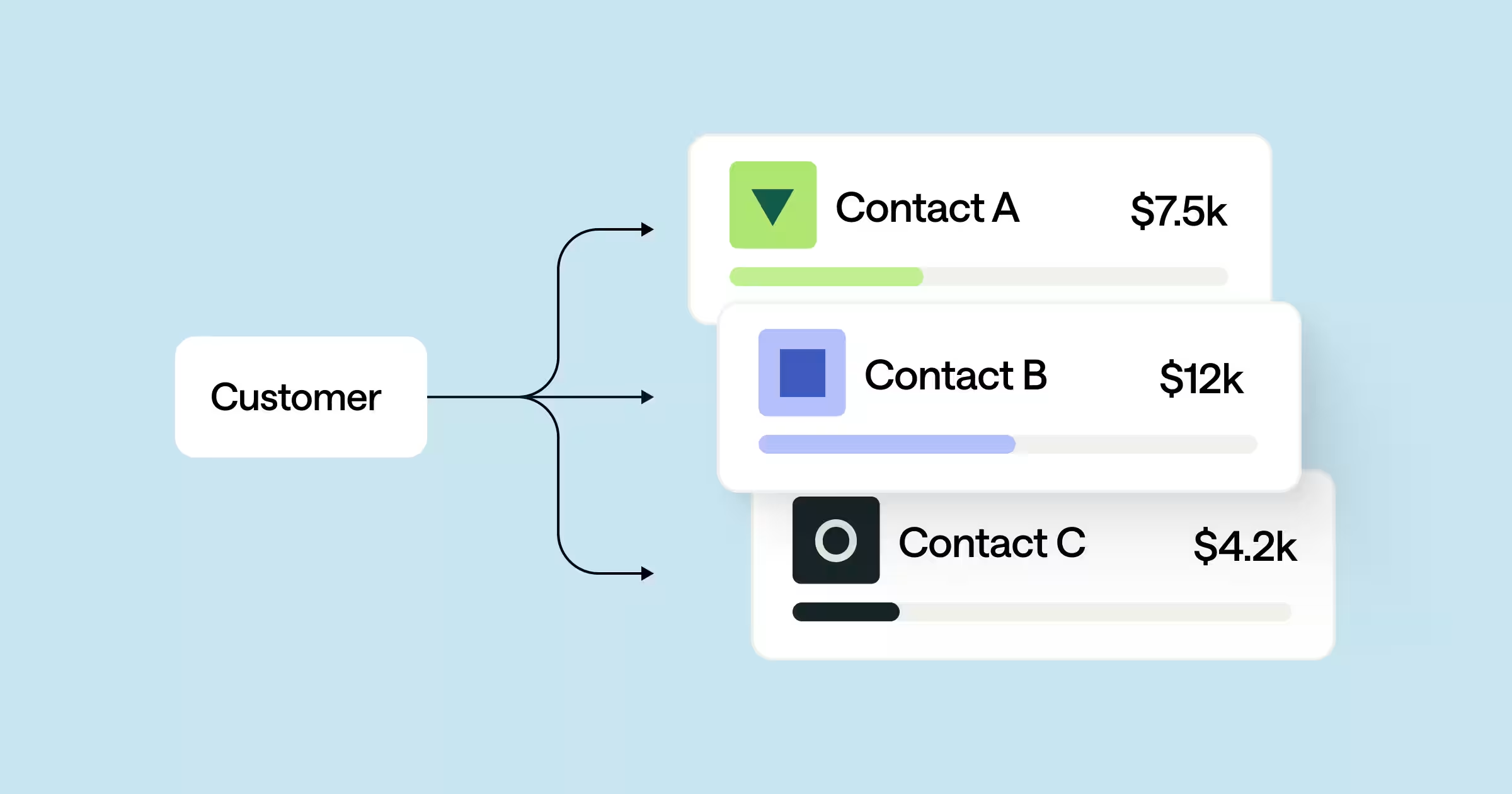
The agentic checklist item: Can your billing infrastructure handle nested accounts or sub-pools? If a customer has one main account but deploys 50 different agents, can those agents be capped individually? This is where it’s worth slowing down to think through how to design for these per-customer-plus-agent proliferations.
Value over tokens: Agents don't care about token counts. What they do care about task completion. As agents become the primary buyers, credit models will likely need to shift even further from cost-plus (input tokens) toward outcome-based (successful task execution).
The bridge-to-value transition plan
After all this, you still need a plan for when credits stop making sense. Credits might be a great way to handle known costs and unknown value, but as your product matures, your customers will demand more predictable, value-aligned pricing.
The requirement: Now, what you need is a billing system that lets you experiment without a total rewrite. Can you change your credit price for one specific segment of customers, without affecting everyone else? Can you A/B test a pay-per-result model against a credit-pool model?
The infrastructure choice: If your billing logic is hard-coded into your app, you’ll be stuck in the credit trap forever. You can consider using a monetization platform that separates the usage tracking from the pricing logic.
Quick-scan guide: The AI monetization readiness checklist
A guide for product and finance teams. If you can’t check these off, your credit model may not be ready for production.
Technical infrastructure
- Real-time metering: Can your system ingest usage events and update credit balances in <5 minutes?
- High-cardinality tracking: Can you track usage by user ID, model ID, project ID, and feature ID simultaneously?
- Idempotency: Does your billing system prevent double-counting if an API call retries after a timeout?
- Edge enforcement: Do you have a low-latency gatekeeper to shut off API access the millisecond a balance hits zero?
Customer experience and transparency
- Pre-flight estimates: Can users see the estimated credit cost before they run a job?
- Granular dashboards: Can a customer see exactly which user or project burned their credits yesterday?
- Proactive alerting: Are there automated triggers at 50%, 80%, and 90% of credit consumption?
- Auto-top-up logic: Can customers opt-in to automatically purchase more credits when their balance is low?
Future-proofing: Agentic readiness
- Sub-pool allocations: Can an admin allocate specific credit budgets to a single API key or autonomous agent?
- Machine-readable pricing: Is your pricing logic accessible via API so an agent can check the price before executing a task?
- Hybrid flexibility: Can you switch a customer from credits to pay-per-result without a month-long engineering sprint?
Is your infrastructure ready?
Like so much in pricing and monetization, launching credits isn't just about picking a number and updating your pricing page. This is truly an operational commitment. Without real-time telemetry, granular visibility, and the flexibility to handle the coming wave of agentic usage, your AI monetization strategy will struggle to scale.
If you can’t answer questions like, "What happens when an agent burns $1,000 in 60 seconds?" you probably aren't quite ready to launch with credits. But with the right plan in place, credits can be the powerful engine that moves your company from AI experimentation to AI revenue.
Moving to an AI credit model? Get in touch with our team. We’re here to help you evolve your pricing for the AI era.







.avif)