

Executive Summary
Modern pricing is now a product capability, a growth lever, and one of the clearest reflections of how a company creates and delivers value. The shift to dynamic, data-driven monetization models has transformed pricing. Once a static decision, it’s now a continuous system of learning. The organizations that succeed in this new era are the ones that build pricing infrastructure and culture that are designed to evolve.
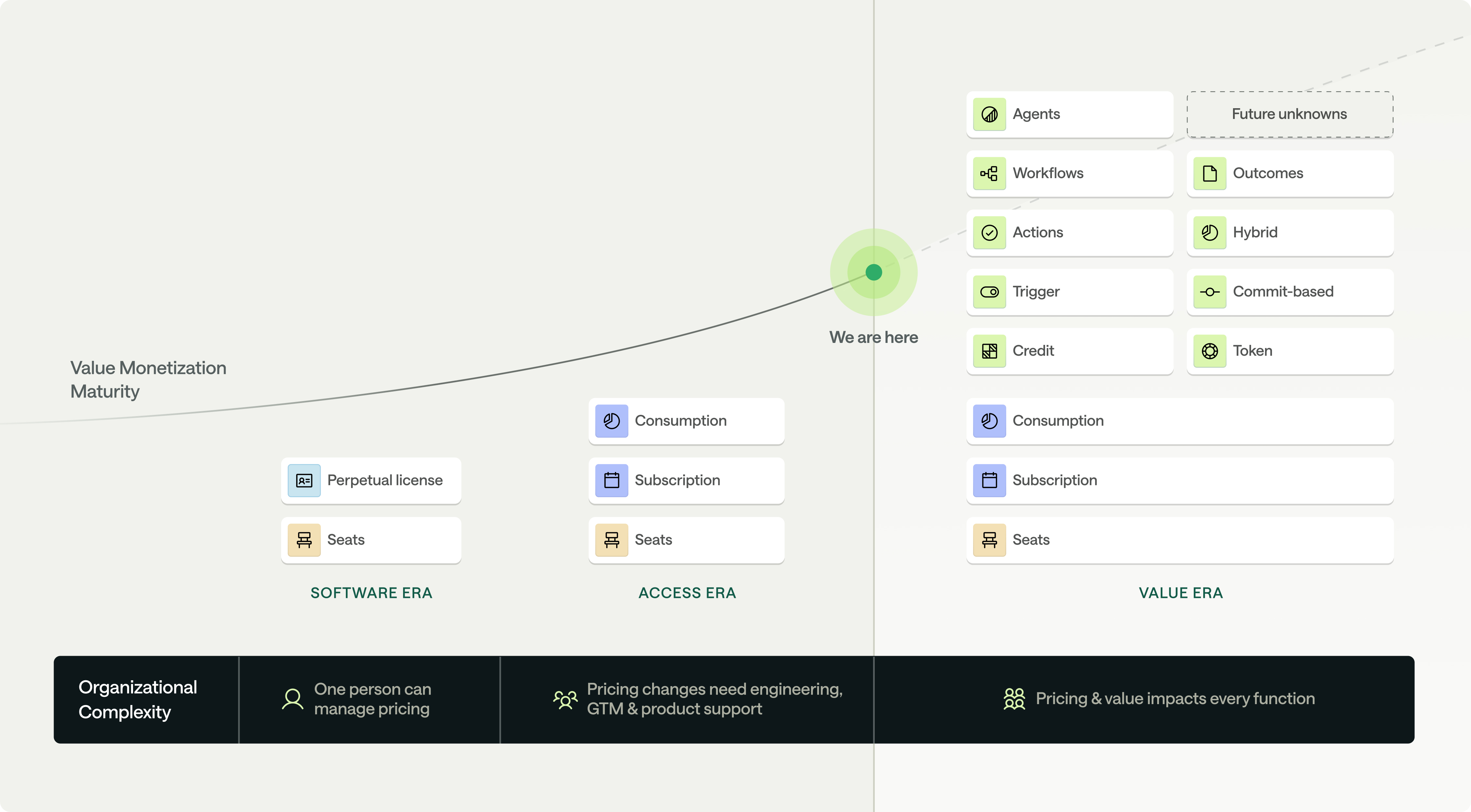
This Pricing Experimentation Playbook is built for that transformation. It’s a guide for product, finance, and go-to-market leaders who want to operationalize pricing as an engine for growth. It outlines how to design a monetization operating model that links pricing to strategy, run structured experiments safely, measure what matters early, and align teams around iteration.
The Pricing Experimentation Playbook
Welcome to The Pricing Experimentation Playbook: a practical guide to building, testing, and refining pricing models that scale with your business. Whether you’re a startup defining your first pricing structure or an established enterprise exploring new monetization levers, this playbook will help you move from intuition to data-driven decision-making.
Each section of this playbook builds on the last. You’ll start by establishing a monetization operating model—the structure that connects pricing to your business strategy. From there, you’ll learn how to run safe, data-driven experiments; instrument key metrics; and align teams to make iteration routine. The final sections explore the
most common pricing models and guide you through adapting your system over time as your product and
customers evolve.
You don’t have to adopt every practice at once. The real goal is to create a foundation where pricing decisions can happen quickly, confidently, and collaboratively, ultimately transforming monetization into a durable, repeatable advantage.
1. Building a Monetization Operating Model
A strong monetization operating model defines what you charge, of course, but more importantly it defines how your company grows. It connects your pricing strategy to product adoption, customer value, and revenue outcomes, ensuring that pricing becomes a strategic growth lever rather than a post-launch afterthought.
Think of it as the connective tissue between your product, finance, and go-to-market motions. A well-run system maps the key levers of your pricing architecture—usage metrics, tiers, packaging, and discounting policies—and assigns clear ownership for how each evolves. When these levers are linked to how customers realize value, pricing becomes a living framework that scales with your business.
In practice, this means bringing structure and accountability to pricing decisions. Product and engineering teams own metering and data integrity, finance ensures alignment with margin and revenue goals, and marketing and sales reinforce the narrative of value in every customer touchpoint. Together, these teams form a monetization rhythm that blends experimentation with governance, enabling your organization to move fast without losing control.
Ultimately, a mature monetization model turns pricing from a static system into an adaptive engine that learns, improves, and compounds value over time.
2. Running Safe Pricing Experiments
Modern pricing has become a core part of the product experience and something customers don’t just accept but engage with. To keep up, pricing needs to be adaptable, measurable, and continuously optimized. Yet in many organizations, even a minor change can trigger complex approvals, manual workarounds, and unintended downstream effects. The most effective companies solve this by baking experimentation directly into their monetization systems, enabling safe, structured iteration without friction.
Pricing experimentation is essential to learning what customers truly value, but it must be done responsibly. The goal is to generate data, not disruption. Structure your tests around hypotheses. Start small, isolate your variable (pricing tier, unit metric, or discount policy), and measure impact on conversion, expansion, and retention. Use control groups and limited rollouts to protect revenue stability.
Always communicate transparently with customers who are involved in experiments, and ensure that your systems are instrumented to capture data from day one. Over time, this disciplined approach turns pricing into a competitive advantage—a feedback loop that continuously sharpens your understanding of value and accelerates growth.
3. Pricing Experimentation Workflow
Modern monetization requires a system that can flex, test, and evolve continuously. Pricing is now a living part of the product experience, composed of entitlements, thresholds, and logic that adapt across product lines, customer segments, and delivery models. But as pricing architectures grow more layered and dynamic, the operational intricacies increase. Each model change affects how usage is tracked, billed, and forecasted, making experimentation risky without the right foundation in place.

A pricing experimentation workflow provides that foundation. It’s a structured, repeatable process for safely designing, testing, and launching new pricing models and enables learning without disruption.
Step 1: Start with a Hypothesis
Define what you’re testing and why. Anchor your experiment in customer value, whether it’s a new unit metric, pricing tier, or packaging strategy, and align stakeholders on success criteria upfront.
Step 2: Build for Flexibility
Design systems that make change easy. Use:
- Versioned pricing catalogs for A/B or multivariate tests
- Feature flags and segmentation for progressive rollouts
- Safe rollbacks and grandfathering to protect existing customers
Step 3: Test Safely
Run controlled pilots with defined segments. Keep experiments small, observable, and reversible. Roll out gradually, and maintain clear rollback paths to minimize risk.
Step 4: Measure What Matters
Instrument everything from conversion to retention. Track results by cohort, SKU, and pricing version to understand both performance and impact. Share data broadly across teams.
Step 5: Learn and Iterate
Treat pricing like code: versioned, testable, and continuously improved. Each experiment builds confidence and clarity, turning pricing evolution into a repeatable advantage.
What Good Looks Like
- Pricing pilots can launch without engineering sprints
- Teams safely test new models in production
- Rollbacks and grandfathering prevent disruption
- Iteration is continuous and guided by real data
4. Key Metrics to Instrument Early
A modern pricing system depends on end-to-end visibility across usage, customer value, and revenue performance. The companies that move fastest in pricing innovation are the ones that can measure impact in real time and act on it. Before running experiments or introducing new models, ensure that your instrumentation captures the right metrics. These will help you measure impact, guide iteration, and demonstrate ROI internally.
Monetization telemetry should include:
- Conversion rate by pricing tier
- Average revenue per account (ARPA)
- Feature adoption and usage correlation
- Customer churn and retention trends
- Revenue expansion via upsells or usage growth
Equally important is how this data is shared. Dashboards should be accessible across product, finance, and go-to-market teams, creating a common language around value realization. When everyone sees the same data, pricing discussions shift from opinion to insight.
Over time, this instrumentation becomes more than measurement; it becomes a monetization feedback loop. It helps teams spot leading indicators of value, identify where pricing is misaligned, and prioritize experiments that drive the greatest impact. In short, the right metrics track performance, and they also unlock the next phase of growth.
5. How to Align Your Team for Pricing Iteration
Building an effective pricing model is an ongoing collaboration that spans every function and influences how value is created, delivered, and captured. Pricing iteration works best when it’s treated as a system, not a series of siloed decisions.
The foundation of that system is alignment across teams and clear ownership:
- Product defines value metrics and monitors usage patterns.
- Finance models revenue scenarios and assesses profitability.
- Sales and Customer Success capture field feedback and customer sentiment.
- Marketing ensures messaging aligns with customer perception of value.
When these groups operate from a shared framework—a single source of truth for metrics, ownership, and decision cadence—pricing iteration becomes not just possible but efficient. Create a rhythm: quarterly monetization reviews, cross-functional working sessions, and defined playbooks for testing and rollout. Treat every pricing decision as a learning opportunity instead of as a verdict.
6. Pricing Model Outcomes: Choosing the Right Fit
The right pricing model reflects how customers experience and measure value. Four dominant frameworks offer different paths to align pricing with product value:
- Usage-based
- Outcome-based
- Seat-based
- Hybrid
Instead of choosing one model to use forever, the most effective organizations evolve as their product, data, and customers mature.
Usage-Based Pricing
Best for: Products where value scales directly with consumption.
Examples: Twilio (per message), AWS (per compute hour), Stripe (per transaction), OpenAI (per token)
Why to Use It: Your customers derive incremental value from each action, transaction, or call. Usage is the clearest proxy for value, and your product’s consumption is one aspect that can be accurately tracked. This model naturally aligns revenue growth with customer adoption: the more they use, the more they pay.
What It Looks Like: Pricing is based on measurable units like API calls, messages sent, data processed, or
compute time.
Key Benefits:
- Fairness: Customers pay only for what they use.
- Growth alignment: Revenue scales with product adoption.
- Low friction: Easy onboarding for small customers; natural upsell path.
- Built-in expansion: Usage growth drives revenue without sales intervention.
Considerations:
- Customers may request spending predictability or usage caps.
- Requires strong metering and billing infrastructure.
- Transparency around cost drivers is key to maintaining trust.
- Enterprise contracts often need commitment tiers or volume discounts.
Next Steps: Define your core usage metric, instrument consumption accurately, and give customers visibility into their usage and spend. Communicate thresholds clearly and design for predictability without losing flexibility.
Outcome-Based Pricing
Best for: Products that autonomously deliver measurable business results.
Examples: Intercom Fin (per resolution), Chargeflow (per chargeback won), Sierra (per outcome)
Why to Use It: Your product does the work. Customers care about outcomes—conversions, savings, incidents prevented, etc.—rather than how often they interact with your platform. You can measure and attribute those outcomes confidently.
What It Looks Like: Customers are charged per result achieved, such as revenue recovered, tickets resolved,
or leads qualified.
Key Benefits:
- Aligned incentives: You win when your customers win.
- Premium positioning: Commands higher prices for clear ROI.
- Reduced adoption risk: Customers pay for outcomes, not effort.
- Value expansion: As your impact grows, your revenue grows.
Considerations:
- Requires strong attribution models to prove outcomes.
- May need baseline or minimum fees to ensure revenue stability.
- Sales cycles can lengthen due to ROI validation.
- Must clearly define what counts as an “outcome.”
Next Steps: Instrument data pipelines that tie your product directly to measurable results. Build trust by surfacing ROI transparently. Consider hybrid “base + outcome” pricing to balance risk and reward.
Seat-Based Pricing
Best for: Collaborative or productivity tools with consistent per-user value.
Examples: Slack (per user), Figma (per editor), Salesforce (per seat), Notion (per user)
Why to Use It: Each user or seat provides steady, predictable value through active use. This model is simple, familiar, and budget-friendly for customers, making it easy for finance teams to forecast and for sales to explain.
What It Looks Like: Pricing is tied to the number of users or accounts, often structured in feature-defined tiers (Free, Pro, Enterprise).
Key Benefits:
- Predictability: Stable revenue and budgeting.
- Simplicity: Easy to understand and communicate.
- Natural expansion: Revenue grows as teams grow.
- Finance alignment: Predictable costs simplify procurement.
Considerations:
- May under-monetize power users who derive disproportionate value.
- Can inhibit adoption if seat costs are a budget constraint.
- Doesn’t capture value from automation or AI features that replace manual work.
Opportunity to Evolve: Layer in usage-based elements for AI or automation capabilities. This hybridization helps you capture additional value beyond user count while maintaining predictability.
Hybrid Pricing
Best for: Products that deliver value through both access and activity.
Examples: Cursor (user + requests), Clay (fixed + credits), Canva (user + AI credits)
Why to Use It: You deliver value on multiple dimensions—access, automation, and usage—across diverse customer segments. Hybrid pricing balances predictability with flexibility, aligning well for complex products or evolving
business models.
What It Looks Like: A combination of base platform or seat fees plus variable usage- or outcome-based charges.
Key Benefits:
- Flexibility: Capture value across multiple drivers.
- Predictability + fairness: Base fees ensure stability; usage scales with success.
- Segment adaptability: Serves both SMBs and enterprises effectively.
- Future-proof: Evolves easily as your product matures.
Considerations:
- More complex to explain and sell.
- Must have clear communication about both pricing dimensions.
- Requires sophisticated billing infrastructure.
- Finance teams need a firm understanding of variable components.
Implementation Paths:
Explicit Hybrid: Flat fee + metered usage (e.g., $50/user + $0.01/API call).
Tiered Hybrid: Packages that include bundled usage (e.g., Pro = 10K credits/mo).
Next Steps: Map which features deliver predictable versus variable value. Ensure your billing and analytics systems can support flexible measurement. Hybrid models thrive when supported by transparency and customer education
7. Putting It All Together
The most advanced pricing organizations treat monetization as a living system that learns, evolves, and compounds value over time. Every decision, experiment, and data point feeds that system, sharpening your understanding of what customers value most and how to capture it fairly.
Building this capability doesn’t happen all at once. It starts with structure, defining a clear monetization operating model that connects pricing to your company’s growth strategy. It matures with experimentation, embedding the ability to test, learn, and adapt safely. And it accelerates through alignment where product, finance, sales, and success teams share ownership of pricing outcomes rather than operating in silos.
Over time, this approach transforms pricing from a reactive task into a strategic discipline. You stop debating “What’s the right price?” and start answering “What’s the right system for learning what this product is worth?” That’s the essence of modern monetization: continuous calibration between how you create value and how you capture it.
The companies that master this balance don’t just keep pace with the market. They define it. Their pricing becomes an extension of their product strategy, a lever for growth, and a signal of customer empathy. When experimentation, data, and collaboration converge, pricing stops constraining your business and becomes what it was always meant to be: a catalyst for innovation and long-term value creation.
Closing
Far from being a static decision made once a year, pricing has become a strategic capability that evolves with your customers, your product, and your market. When you design your organization to learn through pricing, you set your team up to be a leader in the AI era.
Implementation Checklist: Operationalizing Pricing Experimentation
This checklist translates the playbook’s principles into action. Use it to assess your current state, align teams, and build the foundations for a scalable, experiment-driven monetization system.
1. Establish Your Monetization Operating Model
- Define the connection between your product’s value, usage, and revenue outcomes.
- Map the key pricing levers—metrics, tiers, packaging, discounting—and assign clear ownership.
- Build a cadence for regular pricing and monetization reviews (quarterly or semiannual).
- Ensure finance, product, and GTM teams share a common understanding of value drivers.
2. Build for Experimentation
- Treat pricing as a testable surface of your product: flexible, measurable, and safely deployable.
- Implement guardrails for running structured experiments (e.g., limited rollouts, regional pilots).
- Create experiment templates that define hypotheses, variables, and success metrics.
- Centralize results and learnings to accelerate future testing.
3. Instrument Your Data Early
- Ensure full visibility across usage, adoption, conversion, and revenue data.
- Establish consistent measurement for key metrics (ARPA, churn, feature adoption, expansion).
- Build dashboards accessible to all stakeholders for transparency and shared insight.
- Automate data capture wherever possible to reduce manual tracking and latency.
4. Align Your Organization
- Form a cross-functional pricing council or working group with clear roles and decision rights.
- Integrate pricing discussions into regular product and GTM planning cycles.
- Document decision frameworks so teams can act quickly without constant escalation.
- Reinforce pricing as part of your company narrative, and as a reflection of value, not just cost.
5. Evolve with Intent
- Reassess your pricing model as your product, customers, and market evolve.
- Use experimentation data to inform when to adjust, hybridize, or redesign models.
- Treat each iteration as a step toward greater alignment between value creation and value capture.
- Celebrate learning (not just outcomes) to sustain a culture of experimentation.